What Was The March 2026 Google Spam Update?
Unless you’re an SEO junkie like me, you probably don’t think much about what Google is up to behind the scenes.
But just as fast as your favorite Silicon Valley AI bro is releasing new models, Google and other search engines are updating their algorithms to try and keep balance in the chaos AI is unleashing.
Here’s what you need to know about the latest Google Spam Update — and how it might impact your site and your content.
Key Takeaways
Google's March 2026 spam update ran March 24–25, and it was one of the fastest spam rollouts we’ve ever seen (done in just under 20 hours).
The spam update targeted existing spam policies policing things like thin/AI-generated content, link schemes, cloaking, keyword stuffing, and parasite SEO.
Sites with clean, original, voice-forward content likely saw neutral to positive shifts. Spam-leaning sites took hits to their rankings and visibility.
If you were hit and lost traffic, you'll want to think about recovery in months — not days.
This is a reminder, not a surprise — and it’s a good thing. Google keeps raising the floor on content quality.
What is a Google Spam Update?
A Google spam update is a targeted improvement to Google's automated spam-detection systems — separate from a core update, which reshuffles how Google evaluates content quality broadly.
Google runs a lot of updates to its system all the time. Some are big, some are small. These spam updates don’t do a ton except update and strengthen existing rules.
Google often goes after sites that are trying to fast-track their growth using manipulation tactics like keyword stuffing, cloaking, purchased links, thin AI-generated content — any technique designed to game rankings rather than serve readers.
Google runs spam detection constantly in the background. But when they make a significant improvement to those systems — in this case, strengthening SpamBrain, their AI-powered spam filter — they’ll announce it publicly as a spam update.
Remember the golden rule here: If you play by the rules and create content that’s authentic and helpful, you’ll be safe.
Sites that get hit aren't usually surprised by the rules. They're surprised the enforcement finally caught up with them.
What was the March 2026 Google Spam Update?
I first saw the update in Ahrefs as I was looking through some data for a client. Google announced its March 2026 spam update via its Search Status Dashboard, and logged a start time of March 24 at approximately noon PT and marked it complete on March 25. That’s a total rollout window of under 20 hours.
Probably not interesting for most, but that speed is to me. For context, the prior spam update in August 2025 ran for nearly 27 days. So this was a surgical update.
When you look through the documentation, Google describes the update as a normal spam update.
In short, they’re enhancing and tightening existing automated spam detection systems (including SpamBrain, its AI-powered spam-prevention tool) — so no introduction of new spam policies.
To put it simply, if your site got hit, it's almost certainly because of something already on Google's radar.
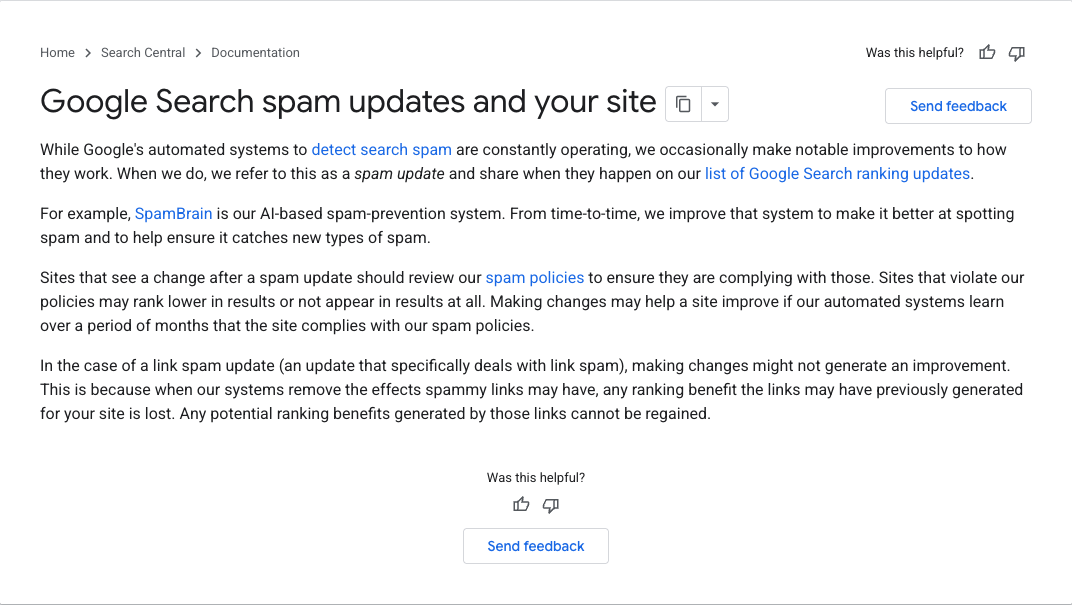
Straight from Google Search Central — sites hit by a spam update should review Google's spam policies and expect recovery to take months, not days. Worth reading in full if you think your site was affected.
What content and tactics did the March 2026 Google Spam Update target?
Google didn't name a single focal tactic in its release, but we can look back at recent updates and existing spam policies to get an idea of what might be targeted:
March 2026 Spam Update — What's at Risk
| Tactic | What It Looks Like | Status |
|---|---|---|
| Scaled AI content | Mass-produced pages with little original value or human judgment | ⚠ High risk |
| Keyword stuffing | Repeating target keywords unnaturally throughout copy | ⚠ High risk |
| Thin / duplicate pages | Content that copies, paraphrases, or mirrors existing material | ⚠ High risk |
| Link spam | Purchased links, link schemes, inorganic backlink profiles | ⚠ High risk |
| Parasite SEO | Third-party content hosted on an established domain to borrow its authority | ⚠ High risk |
| Cloaking / doorways | Showing search engines different content than human visitors see | ⚠ High risk |
| Original expert content | First-person expertise, real examples, genuine point of view | ✓ Safe / favored |
| Natural link profiles | Links earned through content quality, not purchased or schemed | ✓ Safe / favored |
| AI-assisted + human strategy | AI as a tool — not a replacement for judgment, expertise, and voice | ✓ Safe / favored |
If you’re creating content, none of this should surprise you. You can only get away with hacking the system until you get caught.
And Google knows that if it rewards junk content, more will get made. The more that’s made, the less useful Google becomes.
People will stop using it, money goes away, etc., etc.
So you want to keep following the rules when it comes to creating content — even if you’re using AI.
The important note here: using AI in your content process is not the problem. Publishing AI output without editing, strategy, or a distinct point of view is the issue.
Who is getting hit — and who is winning?
It will take some time to know how much of an impact this spam update will have. But we are already getting reports from SEO experts — and a pattern is emerging.
But it’s all anecdotal, so don’t panic just yet.
Sites that are investing a lot of resources into scaled, low-differentiation AI content are seeing pages removed from the index completely. The same is true for those who are using manipulative link-building tools or techniques.
Winners work hard. Sites with strong, original content and clean link profiles appear to be stable or gaining relative ground as competitors drop.
There's also a confounding factor worth flagging: Google AI Overviews and Shopping modules continue to expand across search results. Some "traffic drops" being reported right now may actually be SERP layout changes eating organic click-through, not ranking drops.
Always check Search Console impressions alongside clicks before drawing conclusions.
I think my site might have been affected by the March 2026 Spam Update - what should I do?
Don’t panic — because the reality may be that you’re caught up in the changing trends of search rather than being blacklisted unfairly.
I hear from clients a lot who get on their Search Console, see their impressions and clicks plummeting, and panic.
Don’t worry — do a quick audit to see if there’s anything you should be doing differently in light of this update:
- Check Google Search Console for manual actions — separate from algorithmic updates, but worth checking anyway
- Compare impressions and clicks for key pages from March 22–23 vs. March 25–26 to isolate the update window
- Audit pages for keyword stuffing, thin content, and scaled AI-generated text with no original angle or human judgment
- Review your backlink profile for purchased links, PBNs, or link scheme patterns
- Identify any templated or near-duplicate pages targeting similar queries — consolidate or prune
- Verify GPTBot and other AI crawlers are not blocked in your robots.txt
- Confirm Bing Webmaster Tools is verified — ChatGPT and Perplexity pull heavily from Bing's index
Sources: Google Search Central · OpenAI · Bing Webmaster Tools
A note on link spam recovery: If Google neutralizes spammy links, you’ll find that the ranking benefit is gone. Worse yet, it can’t be reclaimed from those same links. Disavowing is limited in value at this point. So, focus on earning new links through content worth citing.
Is this the beginning of a longer trend?
Probably, because you can imagine that Google and other companies are going to try to keep things clean to keep people using their products.
The March 2026 update is the first spam update of the year, and it follows the December 2025 core update (one that led to some big traffic swings for many domains) and a February 2026 Discover update.
We’re seeing them faster — and completing more quickly — as time goes on.
But here’s the thing: this is only serving to prove what many of us SEOs have been saying for a long time: content that exists to capture a keyword without genuinely serving the reader is becoming harder and harder to sustain in search.
If you want your site to keep growing and reaching (and converting) then you want to create quality content that does two things:
Stays relevant and genuine while sticking to your authentic brand voice
Helps solve problems, educate readers, answer questions from your expertise
Is designed in a way that AI systems want to cite — using original insights, real expertise, first-person specifics, clear authoritative voice, etc.
That's the game now. So while there are tricks to getting fast growth, remember the story of the tortoise and the hare — and create accordingly.
Work with Brad
Your content should sound like you — not like everyone else's AI output.
If this update has you questioning whether your content is working as hard as it should, that's a fair question to sit with. I help B2B and SaaS companies create content that passes the "sounds like us" test and holds up to where search is heading — with AI as a tool, not a shortcut.
Fiverr Pro vetted · 4.9 stars · 1,600+ client reviews
See how I work →Frequently Asked Questions
-
It's a spam update — not a core update — that Google confirmed ran from March 24–25, 2026.
It refreshed and strengthened Google's automated spam detection systems (including SpamBrain) to better enforce existing spam policies.
Rollout completed in under 20 hours, making it one of the fastest spam updates on record.
-
Not automatically — but low-value AI content will.
Google's spam policies target scaled content that provides little original value to users, regardless of how it was produced.
The question isn't whether AI was used; it's whether the result is genuinely useful, original, and reflective of real expertise.
-
Google's own guidance says that after addressing spam policy violations, recovery can take months — not days.
The system needs time to re-evaluate the site after changes are made.
For link spam specifically, recovery is complicated because lost link equity cannot be reclaimed from the same links.
-
A core update is a broad reassessment of how Google evaluates content quality across the board — affecting a wide range of sites and signals.
A spam update specifically targets sites using deceptive or manipulative techniques that violate Google's spam policies.
The March 2026 update was a spam update: targeted, fast, and focused on enforcement rather than reranking.
-
Original content with a clear point of view, real first-person expertise, and genuine usefulness for the reader.
Content that answers a question directly and early, uses structured formatting, and reflects the voice of a real person or brand — not a template.
That's what Google's systems increasingly reward, and it's what AI Overview citations are built on.

Written by
Brad Bartlett
Brad is a copywriter and content strategist who helps creators, brands, and organizations build content that's actually worth reading — and built to be found. He specializes in conversion-focused copy, brand voice, and SEO and AI search optimization, with a straightforward philosophy: great content has to be authentic before it can perform. He works comfortably across the AI content space, helping clients use the tools without losing the voice. Fiverr Pro vetted, 4.9 stars out of 5 across 1,600+ clients.