What is AEO vs GEO?
The One Thing
AEO wins the answer.
GEO wins the attribution.
You need both — but you build them in order.
AEO is a content structure problem you can solve this week. GEO is an authority-building problem that compounds over months. Start with AEO — fix your answer-first structure, add FAQ blocks, apply schema. Then layer in GEO — pillar content, original data, third-party presence. One without the other leaves half the AI search opportunity untouched.
Key Takeaways
AEO optimizes for direct answer selection inside AI results — it’s page-level and works faster.
GEO builds citation authority across the AI ecosystem — it’s entity-level and compounds over time.
You don’t have to choose: AEO and GEO are complementary layers stacked on top of traditional SEO.
In 2026, AI Overviews appear on 48% of Google queries — optimizing for both is no longer optional for serious content strategies.
Start with AEO (fast, structural), then build GEO authority (slower, compounding). Run both in parallel once you have the foundation.
What is AEO? What is GEO? Which should I focus on?
The honest answer? You probably need both.
But they don't have the same job, and you shouldn't build them in the same order.
AEO (Answer Engine Optimization) and GEO (Generative Engine Optimization) are two distinct layers of AI search strategy that work together but operate on completely different timeframes, mechanics, and outputs.
Put another way, AEO makes you the direct answer to a specific question. GEO makes you the most-cited entity on a topic. One is about page structure. The other is about ecosystem authority.
If you're trying to figure out where to put your energy first, this breakdown should help you get an idea of how they differ and where to start focusing right now to get the most bang for your buck.
What’s the difference between AEO and GEO?
AEO (Answer Engine Optimization) helps your content get selected as the direct answer in AI interfaces like voice assistants, featured snippets, and chatbot responses. GEO (Generative Engine Optimization) helps your brand get cited as an authoritative source inside AI-generated summaries and multi-source responses. AEO is about the answer. GEO is about the entity behind it.
I was in a consultation with a client, and they had pulled a report from Hubspot’s free AEO checker - and they showed it to me. Their question - predictably - was “What does this even mean? How do we fix it?”
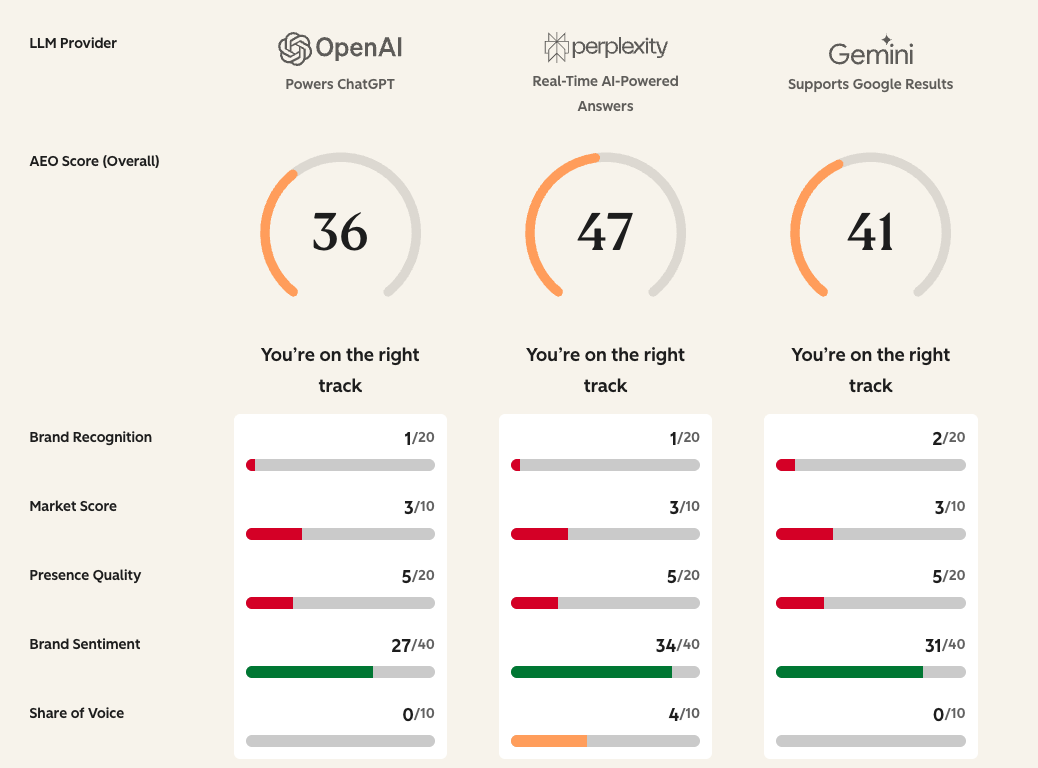
You see all of those reds — and it’s natural to panic.
So think about it like this: when someone asks ChatGPT, “What’s a brand voice guide?” the engine needs to do two things.
First, it pulls from the clearest, most structured answer it can find — that’s AEO doing its job.
Then it attributes that answer to a source it trusts enough to recommend — that’s GEO doing its job.
Both matter, but they require different work and different timelines. AEO is largely a content structure problem. GEO is a reputation-building problem.
If you’ve been running a solid SEO strategy but still aren’t showing up in AI answers, that’s usually a signal that you’ve got the structure without the authority — or the authority without the structure.
Why does GEO vs AEO matter in 2026?
AI search is no longer a niche behavior. As of 2026, AI Overviews appear on nearly half of all Google queries, and over a third of consumers now start their search with AI tools instead of Google. Brands that optimize only for traditional search are increasingly invisible at the moment of AI-generated discovery.
What’s been crazy interesting to watch is how fast this shifted.
Eighteen months ago, “AI search” was still mostly a thing brands were “keeping an eye on.”
Now it’s where a significant chunk of discovery happens before a potential client ever hits your blue-link results.
If you’re a B2B or SaaS brand, this matters even more — because AI-generated answers are the new “google it first” step for every major purchase decision.
The other thing worth knowing: traffic from AI search converts at a dramatically different rate than organic.
I’ve found this stat particularly useful when explaining the stakes to clients who are still measuring everything in clicks 👇
AI search traffic converts at 14.2% — compared to just 2.8% for traditional Google organic. That's roughly five times more valuable per visit, with far fewer sessions needed to move someone to action.
That gap is why visibility inside the AI answer — not just behind it — is the metric that’s going to matter most over the next few years.
And that’s exactly what AEO and GEO are built to capture together.
AEO vs. GEO: a comparison
AEO and GEO address different layers of AI search visibility. AEO focuses on question-level content structure to win direct answer selection. GEO focuses on entity-level authority to earn citations and recommendations across AI-generated responses. Both are necessary; neither replaces the other.
Be selected as the direct answer block
Be cited and recommended inside AI-generated summaries
Question-level answers
Entity-level authority and relationships
Featured snippets, voice results, short AI chat replies
Google AI Overviews, Perplexity summaries, ChatGPT buying guides
Concise, structured, skimmable
Comprehensive, contextual, insight-rich
Answer-first intros, FAQs, question H2s, schema markup
Entity clarity, digital PR, third-party mentions, semantic depth
Featured snippet / answer share
Citation and share-of-voice in AI responses
Page-level changes can show up fast
Entity-building compounds over time
What does AEO optimize for?
AEO optimizes for direct answer selection inside AI interfaces. It works by structuring content so engines can extract a clean, self-contained answer to a specific query. The key tactics are answer-first openings, question-formatted headings, FAQ sections, and structured schema markup.
The core idea behind AEO is simple: write each section so it could be ripped out of context and still work as a complete answer.
If your H2 is “Why brand voice matters,” an AI engine doesn’t know what question it’s answering.
If your H2 is “Why does brand voice matter for B2B content?” and the first sentence under it directly answers that question, you’ve just become citable.
The checklist for AEO isn’t complicated:
Answer-first openings: lead every page and major section with the answer in 1–3 sentences. Don’t wind up.
Question-formatted H2s: write headings the way your readers actually search. Mirror the query.
FAQ blocks: these are your highest-yield AEO asset. Plainly answered questions, 2–4 sentences each.
Schema markup: FAQPage, HowTo, and Article schema tell crawlers what kind of content structure they’re reading.
Modular sections: each body block should stand on its own — 75–150 words, self-contained, scannable.
For the page-level mechanics that make AEO content extractable, this post on structuring pages for AI citation walks through exactly what to build and why each element earns citation differently.
What does GEO optimize for?
GEO optimizes for entity-level authority across the AI ecosystem. Where AEO wins the answer, GEO wins the attribution. It works by building deep topical coverage on your site, earning third-party mentions and citations, and ensuring AI training systems consistently associate your brand with your topic area.
Here’s the part that surprises most brands: your site alone can’t build GEO authority. You need to be out in public talking about what you know. People need to digitally “hear” you.
AI systems build their sense of who’s credible on a topic by scanning the entire web — forums, industry roundups, editorial mentions, Reddit threads, podcast transcripts. If you’re only publishing to your own domain, you’re only working on half the problem.
Here’s what’s moving the needle right now:
Entity clarity: your brand name, category, and value prop should be described the same way everywhere it appears online.
Topical depth: AI systems favor brands that cover a subject comprehensively, not those with a few well-optimized pages. Pillar content and topic clusters are the architecture for this.
Third-party presence: mentions in credible external contexts (not just backlinks) signal to AI models that your brand is worth citing.
Original data and named frameworks: these create citation moats. There’s no other source for your original research. AI systems love citing things that don’t exist anywhere else.
There’s a framework I developed — the Citation Authority Flywheel — that maps out how these GEO elements compound on each other over time.
The short version: original data earns mentions → mentions build recognition in AI training sets → recognition earns citations → citations generate more discovery. Repeat.
Each stage feeds the next.
Brands are 6.5x more likely to be cited via third-party sources than via their own domain in AI search results. Building GEO authority means building off-site presence, not just on-page optimization.
If you’re wondering how to build that kind of topical authority through your content architecture, this post on pillar pages and topic clusters for GEO is the best place to start.
It covers how to design a site structure AI assistants actually understand.
Should you focus on GEO or AEO first?
Start with AEO. It's faster to implement, requires changes to existing content rather than new infrastructure, and produces measurable results within weeks. Once your key pages are structured for direct answer extraction, shift your energy to GEO — building topical authority, earning third-party mentions, and creating original data your AI citations can reference.
The honest take: most brands skip AEO because they think “I just need more content,” and skip GEO because it“s harder to measure.
That’s how you end up with a blog that ranks for nothing and gets cited by no one.
Here’s the sequence that works:
Run an AEO audit on your highest-value pages. Check whether your key service pages, pillar posts, and definitions lead with direct answers, use question-based headings, and have FAQ sections with schema. If they don’t, fix those before building more content.
Retrofit your blog for AEO. You don’t have to start from scratch. Rewriting first paragraphs as answer-first blocks and adding FAQ sections to existing posts is often the fastest GEO and AEO win available to you. This six-step process makes the audit straightforward.
Build topical depth for GEO. Once your pages are answer-ready, invest in pillar content that covers your topic comprehensively. Think: a cornerstone post, 4–6 supporting cluster posts, a glossary or definition page, a named framework or original data piece.
Build off-site entity presence. Pursue mentions in industry roundups, contribute original data to discussions where your audience gathers, and create content designed to be cited externally. The goal is to get your brand name appearing alongside your topic across the web.
Track AI visibility, not just rankings. Run 10–15 weekly prompts across your core topics in ChatGPT, Perplexity, and Gemini. See what’s being cited instead of you, and let that drive your content and PR priorities.
The integrated AEO vs GEO playbook
A full AI search strategy stacks three layers: traditional SEO as the technical foundation, AEO to win direct answer selection, and GEO to build entity-level citation authority. Each layer builds on the previous one. Brands running all three report significantly more organic reach than those investing in SEO alone.
Crawlability, technical health, keyword-mapped pages
Answer-first intros, question H2s, FAQ sections, schema markup
Pillar content, entity building, digital PR, third-party presence
AI visibility audits, citation tracking, quarterly content refreshes
What’s been interesting in practice: the brands I see getting cited consistently in AI results are the ones with the most coherent content — a clear topic lane, answer-ready structure, and enough external presence that AI systems have been trained to treat them as reliable sources.
That’s the integrated strategy at work.
Of brands are still optimizing primarily for traditional SEO, underinvesting in GEO and AEO despite AI-driven surfaces taking more of the discovery journey. That gap is your competitive window — if you move now.
What content formats perform best for AEO vs. GEO?
For AEO, the highest-performing formats are FAQ sections, definition blocks, step-by-step guides, and comparison tables with clear takeaways — anything an engine can extract as a direct answer. For GEO, original research, named frameworks, comprehensive pillar pages, and data-backed roundups earn the most consistent citations.
A few formats that do double duty — strong for both AEO and GEO:
Definition pages: a single-concept page that clearly defines a term, explains how it works, and includes a FAQ block. This is one of the most consistently cited content formats in AI answers.
Comparison posts: structure them with a clear summary table, answer-first intro, and a “bottom line” section. AI systems pull the table. Readers trust the analysis.
How-to guides with numbered steps: each step should open with a one-sentence summary AI can extract independently.
Named frameworks: a proprietary methodology or framework creates a citation moat that no other source can replicate. This is the highest-leverage single piece of content you can create for long-term GEO authority.
For a deeper breakdown of which formats generate the most AI citations and why, my guide on content formats and AI citation covers the research in detail.
Frequently Asked Questions
-
Not exactly, though there's significant overlap. AEO is a broader strategy that includes featured snippets, but also covers voice search results, AI chatbot answers, and direct answer blocks in AI Overviews.
Featured snippets are one surface AEO can win. AI Overviews, Perplexity answers, and ChatGPT replies are others — and each requires the same underlying approach: structured, answer-first content.
-
Yes. The most accessible GEO starting points don’t require a PR firm. A small-scale survey of your audience (even 20–30 responses) creates citable data. A named framework that organizes your process or methodology creates a citation moat.
Contributing insight to Reddit threads, LinkedIn discussions, and industry roundups where your audience gathers builds the off-site presence GEO requires. Budget helps with scale, but the fundamentals don’t require it.
-
AEO results can show up in weeks — answer-first structural changes to existing pages are fast to implement and fast to index.
GEO takes longer because it’s building entity-level authority across the web, which requires consistent publishing, external mentions, and time for AI training cycles to reflect your brand’s growing presence.
Expect 3–6 months before GEO investments start producing measurable citation gains.
-
Yes — SEO is the foundation that makes both AEO and GEO possible. Your pages have to be crawlable, indexable, and technically sound for AI engines to retrieve and cite them.
Strong keyword targeting and information architecture also help AI systems understand what your content is about.
Think of it as a stack: SEO is the infrastructure, AEO is the content layer, GEO is the authority layer.
-
Run a consistent set of prompts across ChatGPT, Perplexity, and Gemini — 10 to 15 per week across your core topic areas.
Note which brands and sources are cited, which questions are answered without attribution, and where you appear versus competitors.
Over time, track whether your brand citation frequency increases.
Tools for automated AI visibility monitoring are emerging, but prompt-based audits remain the most reliable method in 2026.
-
Not necessarily every page, but your highest-value content should be optimized for both.
Prioritize:
Service pages
Pillar blog posts
Definition and explainer pages
Comparison and vs. posts
Any page that addresses a question your ideal client is actively searching.
For thinner or transactional pages, AEO optimization (answer-first structure, FAQ block) is usually sufficient.

Written by
Brad Bartlett
Brad is a copywriter and content strategist who helps creators, brands, and organizations build content that's actually worth reading — and built to be found. He specializes in conversion-focused copy, brand voice, and SEO and AI search optimization, with a straightforward philosophy: great content has to be authentic before it can perform. He works comfortably across the AI content space, helping clients use the tools without losing the voice. Fiverr Pro vetted, 4.9 stars out of 5 across 1,600+ clients.