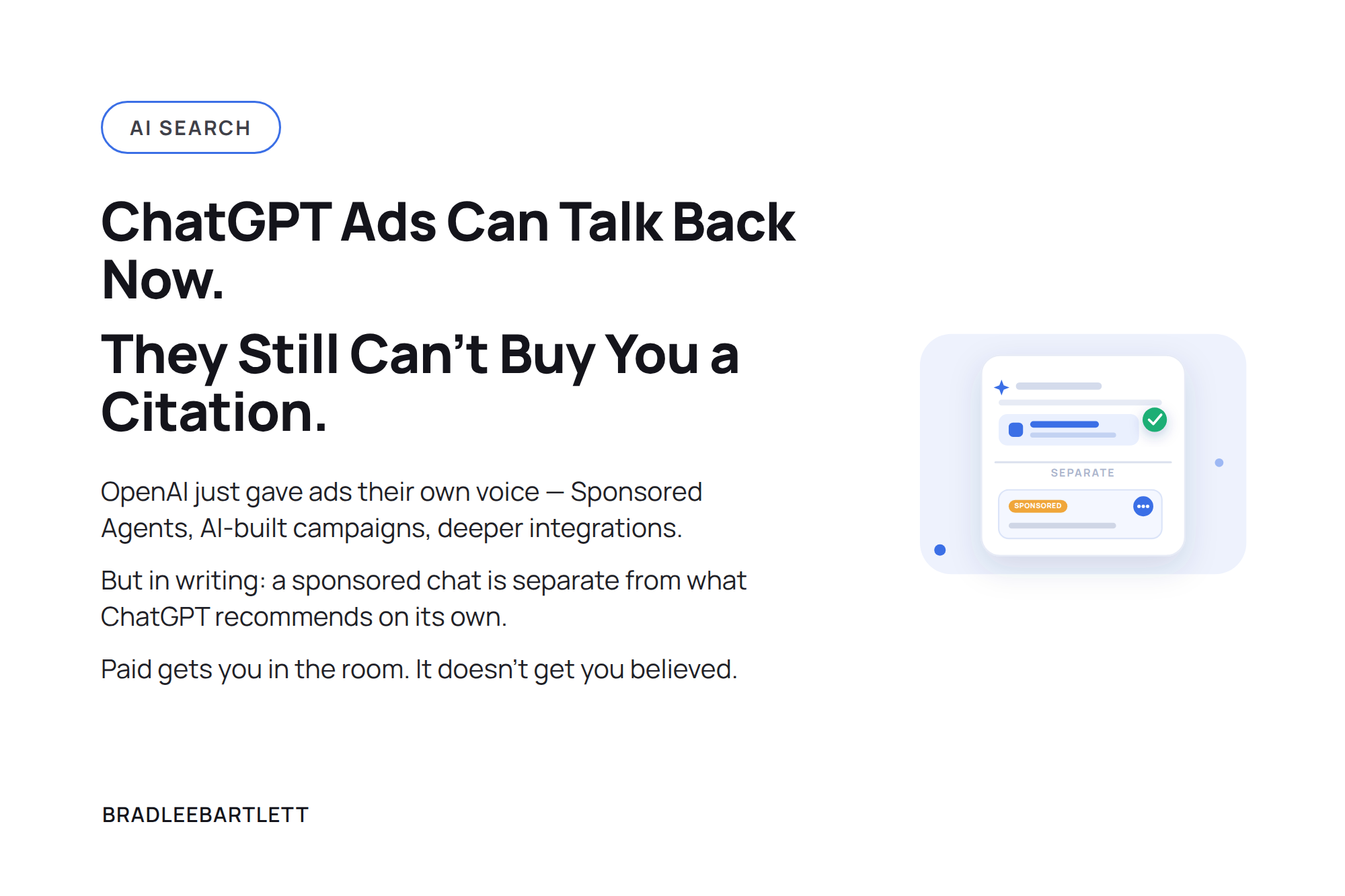
ChatGPT Has Ads. Your Content Needs to Earn the Right to Appear Next to Them.
ChatGPT ads are live. The AI's organic answer next to your ad is what the prospect trusts — and you don't write it. Build the organic citation authority first, then run the ads.
What is AEO vs GEO?
AEO and GEO aren't competing strategies — they're two different layers of the same problem. Here's how to tell them apart, sequence them right, and stop leaving AI search visibility on the table.
AI Overviews and Bing’s New AI Metrics Mean Your KPI Dashboard Is Out of Date
Your dashboard was built to measure a search environment that no longer exists. AI Overviews are absorbing clicks your rankings used to earn — and Bing just shipped the first free tool that shows how often your content gets cited inside AI answers. Here's how to rebuild your KPIs around both.
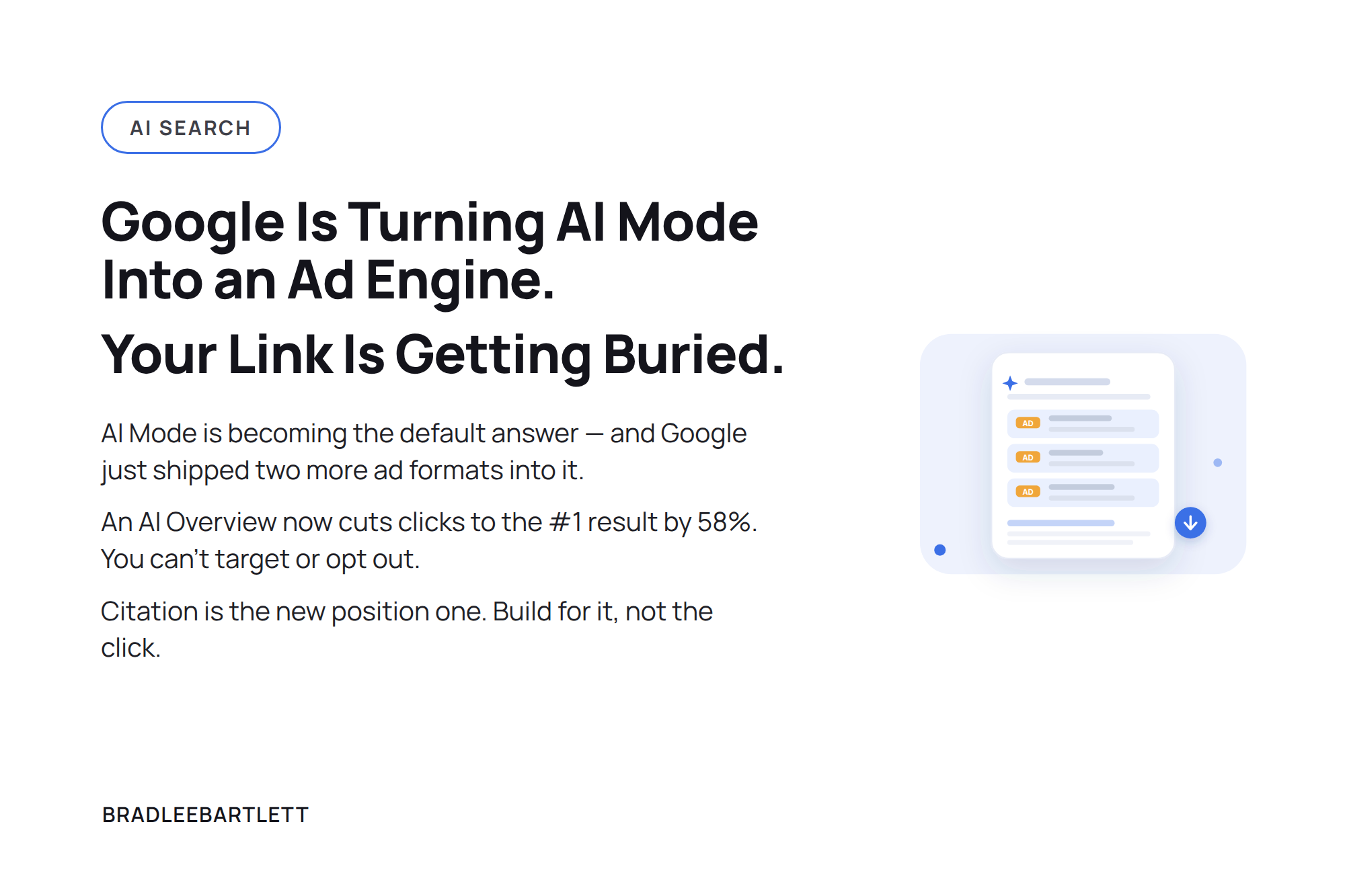
AI Overviews Are Eating Your Clicks. Here’s How to Stay Visible.
AI Overviews are now triggering on roughly half of all Google searches. When they appear, the #1 organic result loses around 58% of its clicks. Here's what that means for your content strategy — and how to become the source Google's AI names.
Does Your Internal Linking Pass the AI Test?
Most B2B blogs treat internal linking as an afterthought. For Google and AI assistants, your links are the map that determines what gets cited. Here's the architecture to build it right.
How to Measure Your GEO Performance (8 Metrics to Track)
Your Google Analytics dashboard wasn't built to track AI citations. Here are the 8 GEO metrics that tell you whether AI systems are noticing, citing, and trusting your brand.
What Did the Google March 2026 Core Update Change?
Google's March 2026 Core Update completed April 8 after 12 days. Three signals got re-weighted: Information Gain, verified authorship, and topical depth. Here's what changed, who got hit, and what to do now.
How to Build Off-Site Brand Signals That AI Uses to Cites You
Getting cited by AI includes what the rest of the web says about you. AI systems build their understanding of brands from reviews, Reddit threads, LinkedIn posts, and industry mentions. If your brand is invisible off-site, AI treats it as unvalidated. Here's how to change that.
Does Being Cited by AI Drive Traffic? What the Data Says in 2026
Being cited by AI tools like ChatGPT and Google AI Overviews rarely translates into a flood of direct traffic — at least not yet. But the brands showing up in AI answers are building something more durable: trust and authority at the exact moment a buyer forms an opinion. Here's what the data says.
Your Brand Voice Is Now an AI Search Signal - Are You Being Heard?
AI doesn't cite the best content — it cites the most recognizable content. If your brand voice guide was built for human writers, it's probably invisible to the systems that now control discovery. Here's how to fix that.
GPT-5.4 Changed Who Gets Cited in ChatGPT — And Most Brands Are Optimizing for the Wrong Model
New data from a 1,161-citation study reveals a 7x gap between ChatGPT's free and premium tiers. GPT-5.4 cites brand websites 56% of the time. GPT-5.3 cites them just 8%. Here's why most brands are optimizing for the wrong model — and what to do about it.
What Should I Include in My Content to Get Cited by AI?
AI tools don't cite the best content. They cite the most extractable content. Here's what that actually means — and the six elements that give every page the strongest chance of showing up in ChatGPT, Perplexity, and Google AI Overviews.
How to Structure a Page So AI Tools Can Extract and Cite It
AI tools don't read your page, they retrieve passages from it. Here's what that means for how you write and format every section, heading, and block of copy you publish.
What Content Formats Get Cited Most Often by AI?
Listicles account for 35.6% of all AI citations. But the reason why reveals the mechanical logic behind how AI systems decide what's safe to cite. Here's what the data shows, and how to apply it to whatever you write.