AI Overviews Are Eating Your Clicks. Here’s How to Stay Visible.
The One Thing
Ranking gets you on the page.
Being cited gets you in the answer.
AI Overviews now appear on roughly half of all Google searches — and when they do, the #1 organic result loses around 58% of its clicks. Your new content goal? Becoming a source Google's AI is confident enough to name.
Key Takeaways
AI Overviews now appear on roughly half of all Google searches — up 58% year-over-year — and 58% of searches end without any clicks at all.
When an AI Overview is present, the #1 organic result loses approximately 58% of its click-through rate. Ranking and getting traffic are no longer the same thing.
B2B technology, education, and healthcare are now effectively AI-first SERPs. If you publish in those spaces, the Overview is your primary competition.
Being cited inside an AI Overview reverses the traffic loss. Sites cited as sources see CTR increase from around 0.6% to 1.08% — in a zero-click environment, that’s significant.
The signals that earn AI Overview citations are the same ones that survive core updates: topical authority, structured content, schema markup, and verifiable author expertise.
I’ve been working with a luxury outdoor furnishings company for a couple of years now. Recently, we noticed that their site’s traffic was down, particularly when it came to their blogs.
But their rankings looked mostly stable in Search Console and Ahrefs.
Once I dug deeper, I found that they weren’t tanking in the traditional sense — they just weren’t getting the clicks they used to.
Naturally, their question was “Is this a Google penalty, or is something else going on?”
The content is good — after all, I wrote a lot of it. I know it, I trust it.
Something else was going on.
What they were experiencing is the quiet version of one of the biggest structural shifts in search right now:
AI Overviews — Google’s generative answer boxes that synthesize multiple sources into a single response above the organic results — are now triggering on roughly half of all Google searches.
They’ve grown 58% year-over-year. And when they appear, the #1 organic result sees its click-through rate drop by as much as 58%.
You can hold your ranking and still lose nearly half your clicks. That's the new math, and it’s ruining the traditional SEO thought process.
I want to be precise about what’s happening here, because the anxiety I see in these conversations is usually pointed in the wrong direction. Teams are auditing their content and debating whether to publish more or less. Some are giving up on posting anything at all.
The actual problem is simpler and more structural. The search result page itself has changed.
The question worth asking is not “how do I rank better” but “how do I become the source that gets cited when Google answers first”.
So, let’s answer that right now.
What it looks like in the wild
Google AI Overview
A Google AI Overview appearing above organic search results. The cited sources appear as cards to the right — being named there is now more valuable than holding position one in the blue links below.
How Big Have AI Overviews Actually Gotten?
AI Overviews now appear on approximately 48–55% of all Google searches, up 58% year-over-year according to a 12-month BrightEdge analysis. In some industries, they trigger on more than 80% of tracked queries.
The scale of this shift is still underappreciated because so many business owners don’t pay much attention to their digital traffic.
A 12-month analysis tracking queries from February 2025 to February 2026 found AI Overview presence growing from about 31% to 48% of tracked searches — with peaks crossing 50%. Other datasets put the figure closer to 55%.
To put that in practical terms: if your content targets informational or research-stage queries — the kind B2B buyers use when they’re figuring out what they need and who to talk to — there is now roughly a coin-flip chance that the person asking that question sees a Google-generated answer before they ever see you.
And this isn’t a fringe experiment anymore. AI Overviews now appear in 200 countries and 40 languages.
This means Google has built this into the core search experience, not a separate product.
It IS the product.
By the numbers
Year-over-year growth in AI Overview presence across tracked queries, February 2025 to February 2026.
Which Industries Are Already AI-First SERPs?
B2B technology search went from 36% to 82% AI Overview presence in 12 months. Education went from 18% to 83%. Healthcare is now at approximately 88%. If your buyers search in these spaces, the AI box is your primary competition for their attention.
I’ve been collecting as much data on these changes as I can lately.
Here’s the data point I keep sharing with B2B and SaaS clients, because it tends to land differently than the aggregate numbers:
| Industry | Feb 2025 | Feb 2026 | Change |
|---|---|---|---|
| Healthcare | ~60% | ~88% | +28 pts |
| Education | 18% | 83% | +65 pts |
| B2B Technology | 36% | 82% | +46 pts |
| Restaurants | 10% | ~78% | +68 pts |
| Insurance | ~40% | ~63% | +23 pts |
That B2B technology number is the one worth a second look: Less than 18 months ago, fewer than 4 in 10 B2B tech searches triggered an AI Overview.
Now more than 8 in 10 do.
If your buyers are researching software, tools, vendors, or solutions in that space, the SERP they’re looking at is fundamentally different from the one your content strategy was built for.
Now, hear me out. This doesn’t mean panic. But it does mean it’s time for a recalibration.
The question your content needs to answer is no longer “how do I rank for this term” — it’s “will Google’s AI use my page as a source when it answers this question?”
Those are related but meaningfully different problems.
Why Ranking Is No Longer the Whole Goal
When an AI Overview appears, the #1 organic result loses approximately 58% of its click-through rate. In full AI Mode search experiences, over 90% of searches end without a click. Ranking still matters — but being cited inside the Overview matters more.
This is the part that trips up most content teams, because Search Console still shows rankings.
That means the positions look fine, but traffic is down. For traditional SEO, this doesn’t make any sense at all.
But there’s a pretty straightforward answer once you see the mechanics at play.
Ahrefs ran a study using December 2025 data and found that when an AI Overview is present, the average CTR for the #1 organic result drops by approximately 58%.
Put plainly, for every 100 clicks that position would historically earn, the AI box absorbs roughly 58 of them.
The user gets what they came for — an answer — without clicking anything.
Earlier case study data had put this figure around 34%. The trend is moving in one direction. 58% of searches now end without any clicks at all.
In AI Mode experiences — Google’s full-page AI answer interface — that figure climbs to over 90%.
What it looks like in the wild
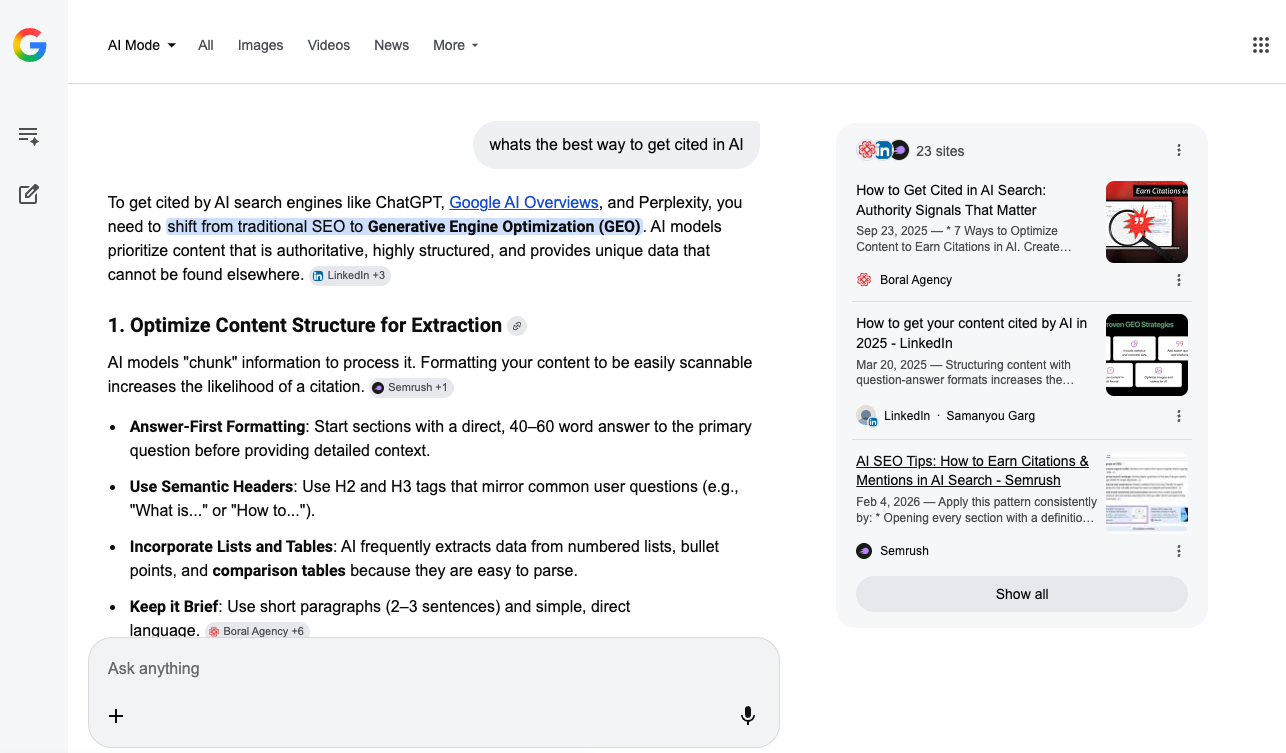
But here’s the number that reframes the whole conversation: sites that are cited inside an AI Overview see their CTR increase from around 0.6% to 1.08% (according to SEMrush data from a Seer Interactive study of 7,800+ queries).
That sounds modest in isolation. In a search environment where most searchers never scroll past the AI box, being named as a source is the difference between visibility and irrelevance.
The strategic shift this requires: stop optimizing exclusively for position 1 and start optimizing for source-worthiness — the quality of being a page Google’s AI is confident enough to name as a reference.
By the numbers
Drop in position-one organic CTR when an AI Overview is present, per Ahrefs' December 2025 data.
How Do AI Overviews Choose Their Sources?
AI Overviews function as a meta-featured snippet: they synthesize multiple pages into a single answer and cite a handful of sources. Pages are chosen based on existing organic authority, structured formatting, schema markup, topical depth, and how completely they resolve the searcher’s intent.
So, how does Google’s AI system pick sources to show?
AI Overviews are not pulling from a separate index. They’re synthesizing content from pages that already rank well organically and presenting the best-structured answers as citations.
Think of it as a “meta-featured snippet”: Google is doing in seconds what a researcher would do in an hour — reading multiple pages on a topic, identifying the most useful explanations, and assembling a summary with citations.
The pages that get cited are the ones that make that synthesis job easier, plain and simple. They aren’t better or cooler or fancier. They’re just easier for AI to read.
Here’s what GEO research and AI Overview optimization guides consistently identify as the selection signals:
Strong organic rankings: AI Overviews heavily favor pages that already rank well. Traditional SEO is not optional; it’s table stakes.
Schema markup: Article, FAQPage, and HowTo schema are explicitly read by Google’s AI when formulating Overviews. Pages with properly implemented schema are easier to parse and more likely to be cited.
Intent resolution: AI Overviews prioritize pages that fully satisfy the query in a single, self-contained section. A page that makes the searcher click three more links to get the full answer is less citable than one that resolves the question directly.
Topical authority: Sites that go deep on a defined subject area — with interconnected content that covers the topic from multiple angles — are treated as more reliable sources than generalist sites with shallow coverage.
Entity clarity: Consistent brand name, author credentials, and subject matter signals across your site, and off-site presence help Google’s AI attach your domain to the right questions.
The internal architecture of your blog — how your cluster of posts links together, how clearly your pillar pages establish topical authority — is part of what makes you source-worthy.
It’s the map Google’s AI uses to evaluate whether you’re an expert in your space or a site that happens to have one good post.
GEO Content Audit
Not sure if your content is built to be cited? That's exactly what a GEO Content Audit is for.
What to Change in Your Content Strategy
Five content strategy changes move you toward AI Overview citations: tighter topic clusters, answer-first page structure, schema on every post, entity signal consistency, and measurement that tracks AI visibility rather than just organic position.
The adjustments are refinements to a content strategy that probably already has good bones and shouldn’t be too tough to implement (or hand off to an expert!).
Build tighter topic clusters, not broader coverage.
AI Overviews favor sites that go deep on defined subjects over sites that touch many topics lightly.
The hub-and-spoke architecture that improves traditional SEO topical authority is the same structure that makes you source-worthy for AIO. Define your two or three strongest topic territories and build them deliberately before expanding into adjacent areas.
Write for intent resolution, not keyword density.
Every H2 section of every post should be able to stand alone as an answer.
If someone asks that section’s question and your paragraph resolves it completely — definition, context, and practical implication in one place — it’s extractable. If they need to read three more sections to understand your answer, it’s not.
Restructure body sections so each one answers a specific question before it elaborates.
Add schema to every post — without exception.
Article schema, FAQPage schema, and HowTo schema where applicable. Google’s AI explicitly uses structured data when generating Overviews.
This is one of the lowest-effort, highest-leverage changes a content team can make. You can often have an AI tool write it for you, given you know what to ask it.
If your CMS doesn’t support schema injection natively, it can be added via your site’s page code injection or equivalent.
Clean up your entity signals.
Your brand name, author name, subject matter, and service description should be consistent across your site, your author bio, your social profiles, and any off-site mentions.
Google’s AI builds a picture of what your site is authoritative about. Inconsistent or missing entity signals make that picture blurry.
Remember: Off-site brand signal consistency is as important as on-page optimization for AI Overview citation.
Publish original data, named frameworks, and proprietary perspectives.
Generic coverage of well-documented topics gives AI no reason to choose your page over five others with identical information.
The Citation Authority Flywheel is the mechanism by which original content compounds into citations, press mentions, brand recognition, and more citations. In an AI Overview world, this is not a nice-to-have content strategy — it is the primary competitive moat.
What to Measure When AI Is Eating Your Clicks
Standard organic CTR metrics will underreport your actual AI search visibility. The metrics that matter in an AI Overview environment are impressions versus clicks in Search Console (not just position), brand search volume, direct AI referral traffic, and citation spot-checks across ChatGPT, Perplexity, and Gemini.
A team whose content is being cited in AI Overviews may actually be performing better in AI search than their traffic numbers suggest — and a team whose traffic looks stable may be slowly losing the citation battle they don’t know they’re in.
The metrics worth tracking, and what each one tells you:
| Metric | Where to find it | What it tells you |
|---|---|---|
| Impressions vs. clicks by page | Google Search Console | A high impression / low click ratio on a page that historically performed well is a leading indicator of AIO presence absorbing its clicks. |
| Brand search volume | Search Console → Queries filter for brand name | AI citation systems treat brand search as an authority proxy. Growing brand search alongside flat organic CTR means AI is doing awareness work your analytics won't capture. |
| AI referral traffic | GA4 → Traffic source filter for chat.openai.com, perplexity.ai, gemini.google.com | Direct visibility into traffic arriving from AI assistants. Small volumes with high conversion rates are common — this traffic tends to be research-complete. |
| Weekly citation spot-checks | Manual prompts in ChatGPT, Perplexity, Gemini | Ask your core questions and note which URLs surface. This is the most direct measure of citation authority and is not captured in any analytics platform. |
| AIO-heavy SERP impressions | Search Console → filter by pages with AI Overview triggers | Separate your AIO-heavy query traffic from standard organic to isolate the actual CTR impact per topic cluster. |
My full GEO performance measurement framework covers each of these in depth, including how to build a weekly citation tracking routine across the major AI platforms.
For teams that have never tracked this way, that post is the practical starting point.
One counterintuitive finding worth flagging: AI-referred traffic can convert at significantly higher rates than traditional organic search traffic.
The searcher who finds you via a Perplexity citation has already been pre-qualified by the AI’s answer — they know what they’re looking for. That makes low-volume AI referral traffic worth tracking closely even when the raw numbers look small.
The Conversation I Keep Having With Clients
The teams that are holding visibility in AI-heavy SERPs are not doing something exotic. They published consistently on defined topics, structured their content for extractability, and built the kind of original perspective that gives AI a reason to name them specifically.
When I walk through this with clients, the reaction is usually some version of: “we’ve been doing most of this.” And often they have — in pieces.
The gap is in coherence.
A site with ten great posts on a topic, loosely connected and inconsistently structured, is less citable than a site with eight posts that are tightly clustered, answer-first formatted, and all pointing back to a clearly defined pillar.
That means the individual quality is similar — but the AI’s confidence in the source is not.
The March 2026 Core Update reinforced this. The sites that gained were narrower, deeper, and more consistent. The sites that lost had broad coverage and thin depth.
Those outcomes map directly to AI Overview citation patterns — which is not a coincidence. Google is evaluating content for both surfaces with the same underlying quality signals.
The big idea? You probably don’t need more content. You need the content you have to be more architecturally coherent and more deliberately structured for extraction.
If that sounds like the kind of thing that’s been sitting on the to-do list for a while — important but always outranked by the next piece to publish — that’s exactly the pattern a GEO Content Audit is designed to unstick.
Map what you have, identify the gaps, and build a cluster that actually earns the citations your content should be getting.
GEO Content Audit
Your buyers are reading AI answers.
Make sure yours is one of them.
If your traffic is flat while your rankings hold, AI Overviews are likely absorbing the clicks you used to own. A GEO Content Audit maps your full architecture, identifies where your content falls short of citation-ready, and gives you a prioritized action list — so you know exactly what to fix to start appearing in the answers your buyers are already reading.
Fiverr Pro vetted · 4.9 stars · 1,600+ client reviews
Get a GEO Content Audit →Frequently Asked Questions
-
An AI Overview is Google’s generative answer box that synthesizes information from multiple web pages into a single summary, displayed above the traditional organic results for many search queries. It cites a handful of source pages.
AI Overviews now trigger on roughly half of all Google searches, making them the primary content surface on many informational and research-stage queries.
-
For most sites, yes — unless your page is cited as a source inside the Overview. Ahrefs found that when an AI Overview is present, the #1 organic result loses approximately 58% of its click-through rate.
Sites that are cited inside AI Overviews see their CTR increase compared to uncited pages in the same SERP.
The goal is to be a named source, not just a ranked result.
-
AI Overviews favor pages that already rank well organically, use structured schema markup (Article, FAQPage, HowTo), resolve the searcher’s intent completely in a self-contained section, and come from sites with topical authority in a defined subject area.
Structuring your content for AI extraction covers the practical page-level mechanics.
-
AI Overview optimization is one component of GEO. GEO covers all the AI surfaces where content can be cited or surfaced — AI Overviews, ChatGPT, Perplexity, Gemini, and others.
The signals that earn citations across those platforms overlap substantially: original data, topical authority, structured formatting, and verifiable author expertise.
A content strategy built for AI Overview citation will generally perform well across AI search surfaces broadly.
-
Track impressions versus clicks in Google Search Console (a widening gap indicates AI Overviews are absorbing clicks)
Brand search volume as a proxy for AI awareness work
Direct referral traffic from AI platforms in GA4
Weekly manual citation spot-checks in ChatGPT, Perplexity, and Gemini.
This GEO performance measurement framework covers the full tracking system.

Written by
Brad Bartlett
Brad is a copywriter and content strategist who helps creators, brands, and organizations build content that's actually worth reading — and built to be found. He specializes in conversion-focused copy, brand voice, and SEO and AI search optimization, with a straightforward philosophy: great content has to be authentic before it can perform. He works comfortably across the AI content space, helping clients use the tools without losing the voice. Fiverr Pro vetted, 4.9 stars out of 5 across 1,600+ clients.