AI Overviews and Bing’s New AI Metrics Mean Your KPI Dashboard Is Out of Date
The One Thing
If your dashboard only measures clicks,
it can't see half of what search is doing.
AI Overviews now trigger on roughly half of all searches — and Bing just shipped the first free tool that shows how often your content gets cited inside AI answers. Your rankings can hold, your impressions can rise, and your traffic can quietly bleed. The fix is a second column in your dashboard, not a bigger content calendar.
Key Takeaways
AI Overviews now trigger on approximately half of all Google searches. When present, they reduce position-one organic CTR by 30–58%. Your rankings can hold while your traffic quietly bleeds.
Bing’s AI Performance report is the first free, native tool that shows how often your content is cited inside AI answers — not just how it ranks. It’s a visibility dataset, not a traffic dataset.
The KPI shift is from “rank high” to “be selected as the answer.” That requires a second column in your dashboard alongside traditional SEO metrics.
GEO and AI search KPIs include: AI citations, cited page count, grounding queries, Share of Model, and AI-referred traffic. All of these are now measurable.
Your SEO foundation still matters — AI Overviews heavily favor pages that already rank well. GEO sits on top of solid SEO, not instead of it.
Is your content performance dashboard built to measure a search environment that no longer exists?
It’s measuring clicks from blue links in a world where roughly half of all Google searches now surface an AI Overview before a single organic result.
It’s measuring keyword positions in a world where Bing just shipped a free tool that tells you how often your content is cited inside AI answers — a metric that didn’t even exist as a standard KPI 12 months ago.
Two things happened recently that make the old dashboard genuinely inadequate: the continued expansion of AI Overviews and the public launch of Bing’s AI Performance report.
Knowing how each works — and why they should have a spot in your performance dashboard — can improve your visibility into whether your content is really working in the zero-click economy.
What Are AI Overviews and Why Do They Change the Traffic Equation?
AI Overviews are Google’s generative answer boxes that synthesize multiple sources into a single response above organic results. They now appear on approximately 48–55% of all Google searches — and when they do, they absorb clicks that used to flow to the #1 ranked page.
For most, the addition of AI Overviews looks like a minor UI change on the search page. But they’re not. They’re a structural shift in where attention goes on the results page.
A 12-month analysis found AI Overview presence grew from about 31% of tracked queries in February 2025 to 48% by February 2026 — a 58% year-over-year increase. Other datasets put the current prevalence closer to 55%.
On informational and how-to queries — the top-of-funnel content B2B teams rely on most — some analyses show AI Overviews triggering on 70%+ of results pages.
The click impact is documented, and it’s significant. Multiple studies put the organic CTR loss between 30–58% when an AI Overview is present. You can hold position one and still lose more than half your clicks to an answer box sitting above you.
But note: this loss doesn’t show up clearly in a standard rank-and-traffic dashboard.
Positions look fine. Impressions may actually rise as more queries trigger your content as a potential source. But clicks don’t follow — because users are getting their answer before they get to you.
By the numbers
of all Google searches now trigger an AI Overview, up from 31% a year earlier — a 58% year-over-year increase in presence.
What Did Bing Just Ship — and Why Does It Matter?
Bing’s AI Performance report, launched in public preview in February 2026, is the first free native tool that shows how often your content is cited inside AI answers. It tracks total citations, cited pages, grounding queries, and citation trends over time — a visibility dataset that no mainstream tool offered before.
While most of the AI search conversation focuses on Google, Microsoft is also shipping AI-related updates. If you aren’t watching both, you’ll end up imbalanced over time.
In early 2026, Bing released the AI Performance report in Bing Webmaster Tools as a free public preview, available to any verified site.
Here’s what it shows:
Total citations: how many times your content was used inside an AI answer on a given day
Average cited pages: how many unique URLs from your site were cited per day
Grounding queries: the underlying prompts and questions the AI used to retrieve your content — essentially the language that triggers your citations
Page-level citation data: which specific URLs are being cited and how often
Trend data: whether your AI visibility is rising or falling over time
What Bing shipped in February 2026
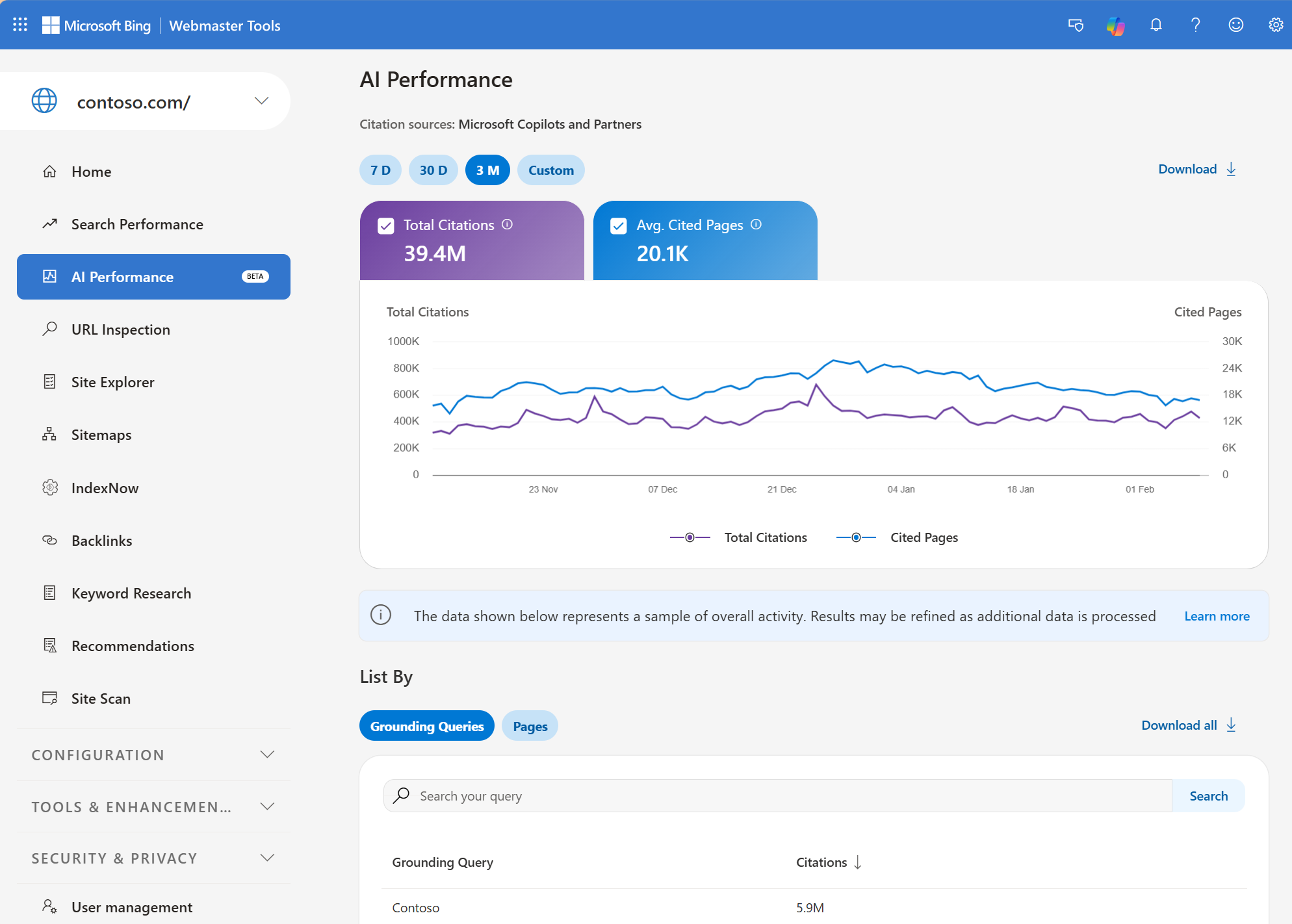
It’s important to note that this is not a traffic report, so it won’t show you sessions or conversions.
What it does show is whether AI systems are using your content as a source — which is the input variable for the traffic you actually want.
A related concept that’s starting to appear in GEO frameworks: Share of Model— how often AI systems choose your brand’s content versus competitors when answering a relevant prompt.
The Bing report is the first mainstream tool that gives you the raw material to start calculating this.
Why Does This Demand a New KPI Dashboard?
The traditional SEO dashboard measures demand harvesting: how well you capture clicks from existing searches. An AI-first dashboard needs a second column that measures demand shaping: how often AI systems choose your content when generating answers. These are different activities requiring different metrics.
As you can imagine, this shift to zero-click AI search creates a core problem for the traditional rankings-and-traffic dashboard: it measures the output of a process (clicks) without measuring the input that now determines whether those clicks occur (AI citations).
You can be getting cited in AI Overviews for dozens of queries — building brand recognition, shaping buyer perception, earning the kind of zero-click authority that influences decisions before anyone fills out a form — and your current dashboard will show you nothing.
It’ll show flat traffic and you’ll assume your content isn’t working.
Conversely, you can be losing citation share to a competitor whose content is better structured for AI extraction, and you’ll have no early warning signal. Your rankings hold, but your traffic drifts.
By the time the problem is obvious, you’ve lost months of compounding citation authority to someone who was measuring the right thing.
The March 2026 Core Update reinforced the same from the SEO side: ranking is no longer sufficient.
The signals Google rewards — topical authority, original data, verifiable expertise — are the same signals that earn AI citations. One content investment, two measurable outcomes. But only if you’re measuring both.
What Should the Two-Column KPI Dashboard Track?
A modern search KPI dashboard has two columns: a traditional SEO column tracking rankings, impressions, and organic conversions; and a GEO/AI column tracking citations, cited page count, grounding queries, Share of Model, and AI-referred traffic.
So, what should your new dashboard look like? To keep it simple, I always say to maintain your traditional SEO tracking, while adding in the essential AI search metrics.
Here’s how the two columns compare — and which tools feed each one:
The Two-Column KPI Dashboard
| KPI | Where to measure it | |
|---|---|---|
| Classic SEO column — keep tracking these | ||
| SEO | Keyword rankings by topic cluster | Google Search Console / Ahrefs / Semrush |
| SEO | Organic impressions and clicks | Google Search Console |
| SEO | Organic CTR by page | Google Search Console |
| SEO | Conversions from organic traffic | GA4 → organic source segment |
| GEO / AI search column — add these now | ||
| GEO | AI citations (total and by URL) | Bing AI Performance (Webmaster Tools) |
| GEO | Grounding queries driving citations | Bing AI Performance → Queries tab |
| GEO | Share of Model for core prompts | Manual sampling: ChatGPT, Perplexity, Gemini, Bing |
| GEO | AI-referred traffic and conversions | GA4 → filter: chat.openai.com, perplexity.ai, gemini.google.com |
| GEO | Brand search volume trend | Search Console → brand name query filter |
| GEO | Pages cited by AI vs. total indexed | Bing AI Performance → Pages tab vs. site: index count |
The GEO column doesn’t replace the SEO column. GEO sits on top of solid SEO foundations — AI Overviews still heavily favor pages that already rank well organically.
But ranking without citation tracking is now an incomplete picture, and the Bing report makes the missing half measurable for the first time.
GEO Content Audit
Not sure which of your pages are citation-ready — or why they aren't? A GEO Content Audit gives you a prioritized action list.
How Do You Build an AI Visibility Dashboard?
Start with three moves: verify your site in Bing Webmaster Tools and pull 90 days of AI Performance data, build a 10-prompt test set for your core topics and run it weekly across ChatGPT, Perplexity, and Gemini, then add AI referral traffic as a segment in GA4. That’s a working dashboard in under two hours.
Your dashboard doesn’t need to be complex to be useful. Here’s the minimum viable version that you can set up pretty quickly and use to build out your strategy moving forward:
1. Verify your site in Bing Webmaster Tools if you haven’t already
It’s free, takes under five minutes with a meta tag, and unlocks the AI Performance report immediately.
Once verified, pull your last 90 days of citation data. Note which URLs are being cited and which grounding queries are driving those citations.
2. Build a 10-prompt test set for your core topics
Write the 10 questions your ideal buyer is most likely to ask an AI assistant. Run them weekly in ChatGPT, Perplexity, and Gemini.
Note which responses cite your content, which cite competitors, and which cite no one you recognize. This is your Share of Model baseline. How to track AI citation patterns covers the mechanics in depth.
3. Add AI-referred traffic as a GA4 segment
Filter traffic sources for chat.openai.com, perplexity.ai, and gemini.google.com.
Even if current volumes are small, conversion rates for this traffic tend to be significantly higher than for standard organic traffic — these visitors have been pre-qualified by the AI’s answer and arrive with strong intent.
4. Map Bing’s grounding queries to your content architecture
Look at which queries are triggering citations and ask: Do you have a cluster of posts built around each one? Is the cited page properly structured with schema, answer-first formatting, and links to supporting posts? Content structure for AI citations walks through exactly what “citation-ready” looks like at the page level.
5. Review both columns monthly, not separately
The insight comes from looking at SEO and GEO data together.
A page with high impressions, stable rankings, and zero AI citations is a retrofit candidate. A page with growing AI citations and low organic traffic is doing awareness work that your attribution model isn’t capturing.
What Content Gets Cited in AI Answers?
AI Overviews and AI answer engines preferentially cite content that resolves a query in a single self-contained section, uses structured schema markup, comes from a topically coherent domain, and includes original data or named frameworks that aren’t available elsewhere.
Getting up to speed with the GEO KPIs only gets you so far. The question underneath them is: what do you do with the data once you have it?
The content types that consistently earn citations are the same ones that make AI’s synthesis job easier:
Comparisons and alternatives pages
Implementation guides with a clear step-by-step structure
FAQ sections that resolve specific questions in 2–3 sentences
Original benchmark data that provides something citable that doesn’t exist anywhere else
The underlying principle is intent resolution: AI systems favor pages that fully answer the question without forcing the user to click through to another resource.
A page that resolves the query completely in one section is more citable than a page that spreads the answer across five.
This is also the reason internal linking architecture matters for AI citation — well-connected clusters signal topical depth, which increases AI confidence in the source.
Brand and entity signals then compound everything. Your brand name, author credentials, and subject matter focus should be consistent across your site, your Bing Webmaster profile, your author bio, and any off-site mentions.
Off-site brand signals are a direct input into the Share of Model metric — AI systems that encounter your brand across multiple credible sources develop stronger entity associations that make citations more likely.
GEO Content Audit
Your content deserves to show up
in the answers your buyers are already reading.
If your dashboard is only measuring rankings and traffic, you're flying blind on the layer of search that's now doing most of the awareness work. A GEO Content Audit maps your full content architecture, identifies which pages are citation-ready and which aren't, and gives you a prioritized action list — so your next quarter of content investment goes exactly where it will compound.
Fiverr Pro vetted · 4.9 stars · 1,600+ client reviews
Get a GEO Content Audit →Frequently Asked Questions
-
Bing’s AI Performance report is a free tool inside Bing Webmaster Tools, launched in public preview in February 2026, that shows how often your content is cited inside AI answers on Bing and Copilot. It tracks total citations, cited pages, the grounding queries that triggered those citations, and citation trends over time.
It is a visibility dataset, not a traffic dataset — it tells you how often AI systems use your content as a source, not how many people clicked through to your site.
-
When an AI Overview appears on a search results page, the top organic result typically sees a 30–58% reduction in click-through rate. Users receive a synthesized answer directly on the page and often end their search without clicking any result.
Sites that are cited inside the AI Overview see CTR increase compared to uncited results in the same search. The full breakdown of AI Overview CTR impact covers the data in detail.
-
Share of Model refers to how often an AI system chooses your brand’s content when generating answers about topics relevant to your business, expressed as a proportion relative to competitors. It’s the AI equivalent of share of voice in traditional media.
Bing’s AI Performance report provides the raw citation data from which Share of Model can be derived. Manual weekly sampling — running your core prompts in ChatGPT, Perplexity, and Gemini and noting whose content surfaces — is the most accessible way to track this metric today.
-
No. GEO builds on top of solid SEO foundations — AI Overviews heavily favor pages that already rank well organically. GEO doesn’t replace the SEO column in your dashboard; it adds a second column that measures what happens above the organic results.
A strong SEO foundation is still table stakes for AI citation. The difference is that ranking alone is no longer the end goal.
-
The signals that earn AI Overview citations are:
Existing organic rankings
Structured schema markup (Article, FAQPage, HowTo)
Answer-first formatting that resolves the query in a single self-contained section
Topical authority built through a coherent cluster of related content
Consistent entity signals across your site and off-site presence

Written by
Brad Bartlett
Brad is a copywriter and content strategist who helps creators, brands, and organizations build content that's actually worth reading — and built to be found. He specializes in conversion-focused copy, brand voice, and SEO and AI search optimization, with a straightforward philosophy: great content has to be authentic before it can perform. He works comfortably across the AI content space, helping clients use the tools without losing the voice. Fiverr Pro vetted, 4.9 stars out of 5 across 1,600+ clients.