Is Profound Worth It for GEO? Honest Review + Alternatives
Key Takeaways
AI-powered GEO tools like Profound are excellent at measuring where you stand in AI-generated answers. But they aren’t content tools in and of themselves, and don't close the visibility gap on their own.
Profound is purpose-built for enterprise brands — Fortune 500-level teams with dedicated analysts, existing content infrastructure, and $400–$5,000+/month tool budgets. For most growing B2B teams and small businesses, this could be overwhelming.
AI search traffic converts at roughly 14.2% versus 2.8% for traditional organic — making GEO one of the highest-ROI content investments available, if the content itself is citable.
No GEO tool can guarantee AI citations. AI responses are non-deterministic. What tools can do is show you the gap — what does and doesn’t get cited and where competitors are winning.
A monitoring dashboard shows your GEO score dropped by 12%. But it can't tell you whether your H2s are keyword fragments or that your FAQ block is buried — both key parts of AI search optimization.
The best GEO outcomes come from combining both: tools for intelligence, expert writers for execution. But that's a $6,000–$ 12,000+ per month commitment that only makes sense at a certain scale.
Since Google’s May 2026 AI guide confirmed that GEO is “still SEO” and deprecated llms.txt, chunking, and AI‑only rewrites, tools like Profound sit even more clearly in the “diagnose, don’t fix” bucket.
I got an interesting message the other day, and it sparked my interest: Have you used Profound to boost your client’s AI visibility?
To be fair, I’d never heard of it until just recently. I’ve been a long-time Surfer SEO fan (from waaaaay back when SEO was all that mattered) and haven’t really broken out to new tools — especially for GEO or other AI visibility stuff.
And tools like Profound — from what I’ve seen so far — deliver on exactly what they promise: to track, measure, and surface AI visibility data so you know how often your brand appears in ChatGPT, Perplexity, and Google Gemini answers.
I’d argue there’s a more important question here: Does having a GEO dashboard do enough to help you boost your AI visibility?
And as I tell all of my clients about “insights and analytics” (who knows what they even mean these days), the answer to that question depends almost entirely on what you do with the data
And that's a content and strategy problem, not a software problem.
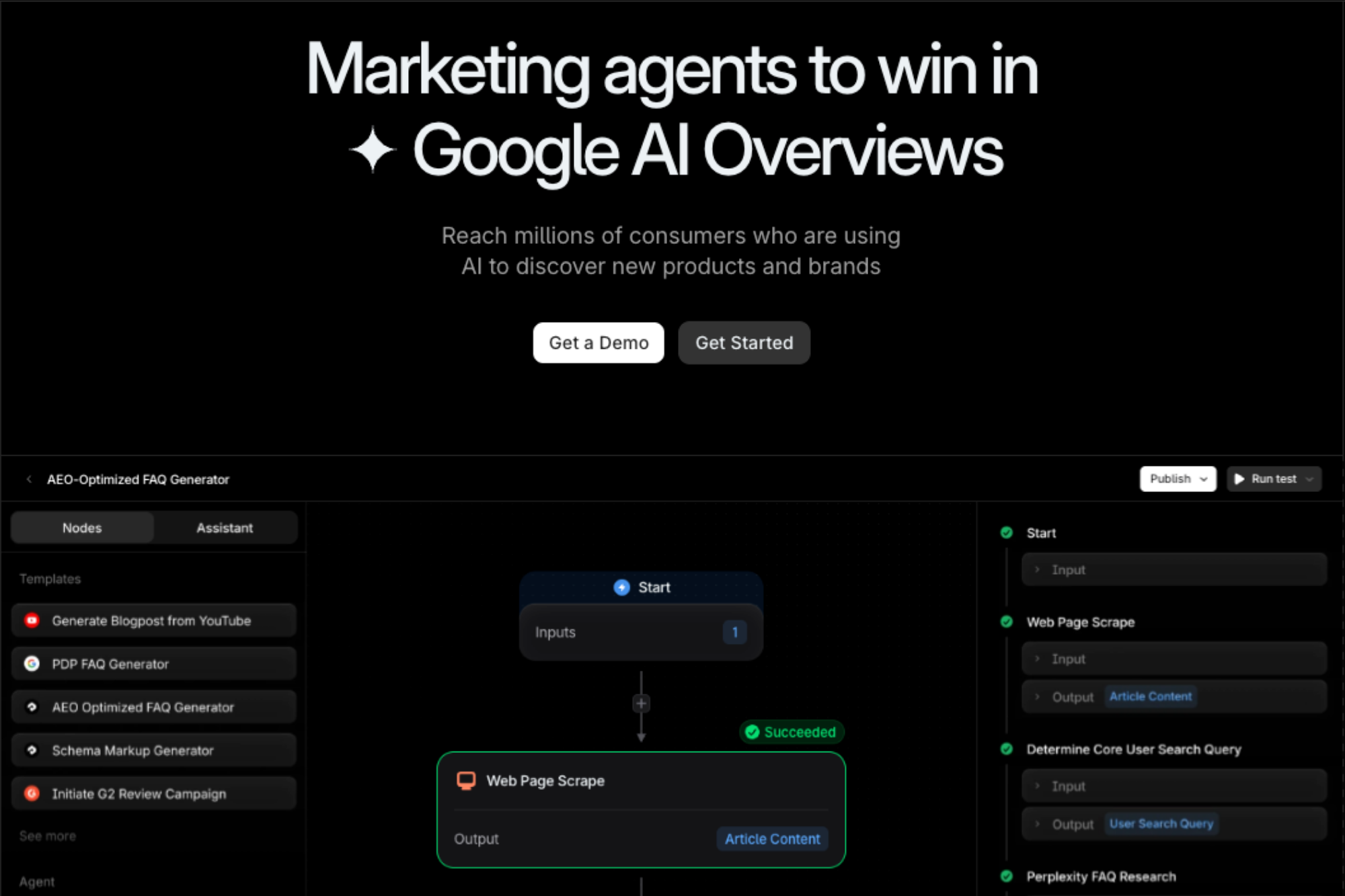
Profound’s platform uses AI agents to complete marketing workflows that aim to boost AI search visibility in a variety of online AI tools. But is it enough to help you stand out in the right way?
Credit Karma for Your AI Visibility?
Remember tools like Credit Karma that promise if you create an account and pay the subscription fee, they’ll instantly raise your credit score ten points?
This new category of software is popping up everywhere, and they’re claiming a similar goal — but they’re calling it “filling the GEO attribution gap”.
Basically, your content is fueling thousands of AI-generated answers, but you have no visibility into when, where, or how.
So, platforms like Profound, AthenaHQ, and Peec AI have stepped in to fill that gap. And as anything with AI slapped on the box, it’s creating a bit of a stir and raising a ton of capital. Profound alone has raised $58.5 million, positioning itself as the first 'read/write' marketing platform for AI.
That's an impressive pitch. But if you're a B2B content manager or company brand trying to show up in AI answers, the tool can only do so much.
So I figured I’d do a bit of a dive into Here's an honest look at what these platforms really do and what they can and can't do — no matter what the pricing page says.
What do GEO tools like Profound do?
GEO platforms like Profound are monitoring and measurement tools. They track how often your brand is mentioned and cited across AI answer engines, show you competitor share of voice, surface real user prompts driving AI queries in your category, and flag where your content is winning or losing AI citations. They do not write content, fix your site architecture, or tell your brand's story.
Profound's core product combines three data layers — and what they call it or how it layers in all depends on the solution:
AI answer analysis (what models say when asked about your category)
AI crawler analytics (which bots visit your site and how often)
Real user prompt data from its Conversation Explorer feature (which surfaces what people are actually asking AI tools, mapped to funnel stages)
Under the hood, this lines up with how AI engines work in 2026:
Google’s AI Overviews sit on top of the existing Search index via RAG and query fan‑out
ChatGPT leans heavily on Bing rankings for live web retrieval
Perplexity still surfaces 5+ citations per answer with a bias toward structured pages and FAQ blocks
And just so I’m not being biased here, I looked at the reviews.
Independent reviewers consistently note that Profound's citation tracking and sentiment scoring are strong, and its G2 reviews say that many enterprise companies see value in its daily LLM visibility monitoring.
But there’s always a catch with “stronger-better-faster-stronger!” SaaS tools. It shows up in a lot of third-party reviews:
Profound shows you where you stand — you still need other tools and a content team to act on what it tells you.
In essence, it’s a diagnostic rather than a prescription. A reviewer wrote that the recommended actions inside the platform were things like 'write a generic listicle.'
So, the data is good, but the execution gap is still wide.
No GEO tool can guarantee that your brand appears in ChatGPT or Perplexity responses.
AI answers are non-deterministic — they vary by prompt, context, and model update. What tools can do is increase your understanding of what's being cited, where gaps exist, and what content formats AI systems prefer.
Closing those gaps still requires someone who knows how to write.
Who are AI visibility tools like Profound built for?
GEO monitoring platforms like Profound are purpose-built for enterprise brands with dedicated analyst resources, existing content production capacity, and tool budgets of $400–$5,000+/month. For smaller B2B teams, agencies, and growing brands, the price-to-value equation rarely works because these teams don't have the bandwidth to act on it.
I always tell people that when it comes to tools, check the pricing to get a feel for who should be using it.
Profound's Starter plan at $99/month covers ChatGPT only — one engine, limited features. Bump up to their Growth tier at $399–$499/month unlocks multi-engine coverage (ChatGPT, Perplexity, Google AI, Gemini).
Full enterprise coverage with API access, historical data, and a dedicated strategist is custom-priced — and consistently described by independent reviewers as being aimed squarely at Fortune 500 budgets.
The pricing is premium, which makes sense for the right buyer.
It does not make sense for a 10-person SaaS marketing team that still needs to produce content, fix the site architecture, and implement the schema for any of this to work.
In other words, Profound assumes you already have the non‑commodity content, answer‑first structure, and technical clarity; it doesn’t create those for you.
But there are some alternatives worth knowing about, particularly when it comes to price point:
Peec AI — clean multi-engine tracking and more mid-market friendly
Otterly.AI — entry-level GEO monitoring starting around $25/month, good for SMBs getting started
Semrush AI Visibility Toolkit — best for teams already in the Semrush ecosystem who want unified SEO + GEO reporting
AIclicks — this platform is interesting, as it tracks brand mentions across 10+ AI platforms (ChatGPT, Perplexity, Gemini, Claude) with daily updates and competitive benchmarking. It could be a legit option if broad cross-platform coverage in one dashboard matters when you’re doing your GEO/AEO testing.
HubSpot AEO Grader — free diagnostic, no ongoing monitoring, but a solid starting point
Surfer SEO AI Tracker — my favorite tool, mostly because I know the Surfer system so well
If you’re really curious about what these tools can offer, it’s worthwhile to sign up for a trial and give it a go.
As of mid‑2026, most of these platforms are racing to add features like prompt‑level analytics and “AI search share of voice” scores, but they still fall into the same category: monitoring layers, not execution engines.
Most will keep a lot behind the paywall, but you can get an idea of the kinds of data you can track. (Just remember to cancel your trial if you aren’t sold!)
You're not showing up in AI search... but you're not sure a $400/month dashboard is the answer.
I work with B2B, SaaS, and SMB teams who need the content foundation built right — answer-first structure, topic clusters, schema, voice — not just a visibility score that tells them they're losing.
GEO tools vs. expert GEO writers: which is better?
Neither is “better” than the other. GEO tools measure visibility. Expert GEO writers build it. The two serve fundamentally different functions — and for most growing B2B brands, confusing one for the other is an expensive mistake.
This is the comparison most people don't usually see when they’re looking for an AI search fix. One isn’t really better than the other.
Data and great writing go hand-in-hand, and I’d argue that if your writer isn’t relying on some tools to track data on how you are (or aren’t) showing up in AI search results, then you’re missing out on optimization potential.
| Factor | GEO Software
Profound, AthenaHQ, Peec AI
|
Expert GEO Writer
Strategy + Execution
|
|---|---|---|
| Monthly cost | $99–$500 starter $400–$1,000 growth $1,500–$5,000+ enterprise |
$500–$4,000/month for 4–8 articles $2,500–$6,000+ retainer |
| Primary function | Monitor and measure: citations, share of voice, sentiment, crawler data | Create and optimize: research-backed articles, FAQs, tables, conversion copy |
| Content creation | Limited or none — some tools generate AI drafts that need heavy editing | Full end-to-end: research, outlining, writing, optimization, internal linking |
| Human judgment | Minimal — tool provides data, you interpret and act | High — expert reads brand context, competitive landscape, audience psychology |
| Your time investment | 5–10 hrs/week reviewing dashboards and briefing your content team | 2–4 hrs/week for briefing and approvals — writer handles the rest |
| Conversion & brand voice | Not optimized for conversion or voice — focused on AI citability, not humans | Dual-optimized: written for AI engines AND human conversion in your voice |
| SEO + GEO integration | GEO-focused — assumes you have separate SEO tools and a content team | Integrated: traditional SEO (keywords, links, meta) + GEO (citations, schema, Q&A) |
| Realistic monthly cost |
Tool + your time + content team
$3,600–$9,900
|
Writer + your time + tools
$2,000–$6,000
|
| Best for | Enterprise teams with existing content capacity that need an intelligence layer | B2B and growth-stage SaaS that need strategy AND execution without a full team |
| Not ideal for | Small businesses without budget to act on insights; anyone who needs content, not just data | Large enterprises producing 50+ pieces/month with strong in-house writing teams |
Here’s some comparison math:
A Growth-tier Profound subscription plus your team's time interpreting dashboards plus outsourced content creation adds up to roughly $3,600–$9,900/month.
An expert GEO writer on retainer — who handles research, structure, writing, and optimization — typically runs anywhere from $500-$2,000/month all-in.
The difference is execution: one approach tells you what's missing, the other fills the gap.
Since Google’s May 2026 guide, a lot of GEO software has quietly dropped or de‑emphasized llms.txt files, AI‑only “rewrite for AI” modes, and special “AI schema” settings — all tactics Google explicitly says it does not need for AI Overviews or AI Mode.
If a sales deck still leans hard on those, that’s a red flag.
What helps boost GEO and AI visibility? Do you need a tool?
AI systems cite content that answers questions directly in the first sentence, is authored by named, credible authors, uses structured formats like FAQ blocks and comparison tables, and sits within a coherent topic cluster that signals topical authority. Google increasingly favors what it now calls non‑commodity content: original cases, first‑hand experience, and proprietary data that can’t be stitched together from existing sources.
I’ve been in this for a long time now. I’ve helped nearly 2,000 different clients with everything from SEO to GEO and even a bit of social media virality.
So here’s my wisdom: most businesses and brands that aren’t showing up in AI search answers have an architectural problem.
Even companies that have spent years creating blogs for “Best X Things in Location” or “How Do I Do This Thing For This Industry?” are losing out on AI search results because of a few key things (many of which a skilled content writer can help with quickly:
The H2s are keyword fragments instead of questions people actually ask AI
There's no FAQ block — the format AI systems pull most reliably for direct answers
The opening paragraph buries the answer instead of leading with it
The content sits in isolation with no internal links connecting it to related posts
There's no author entity, no schema markup, no signal that a real expert wrote it
The page never adds anything new to what’s already ranking — which Google’s March 2026 Core Update now discounts under its Information Gain signal
A GEO tool will surface the fact that your competitor is getting cited for 'what is customer onboarding strategy' and you aren't.
It will not tell you that your post on that topic opens with three paragraphs of context before answering the question, uses 'Best Practices' as an H2, and has no FAQ block.
That’s the gap. And knowing you have a GEO problem and knowing how to fix it is where content expertise lives.
A GEO tool is a diagnostic machine. It tells you your blood pressure is high.
The content strategy and writing — the structure, the voice, the answers — that's the treatment plan. A machine that measures without a doctor who can prescribe is only half the solution.
So, should you invest in a GEO tool like Profound?
If you're an enterprise brand with existing content infrastructure, analyst resources, and a serious tool budget, a platform like Profound is worth evaluating. If you're a mid-market or growth-stage brand, getting your content architecture and writing right first will deliver more GEO improvement per dollar than any dashboard — and the tools will be far more useful once you have strong content for them to measure.
So, should you really invest in a GEO or AI visibility tool? It depends on what you really need. I’ve even told clients that they could benefit from one once I’ve dug into their data and content.
Tools like Profound make a lot more sense once you’ve already shipped a few dozen non‑commodity pieces with answer‑first structure, FAQ schema, and clean site architecture; until then, they’re sophisticated ways to confirm that Google and Perplexity still can’t cite you.
Here's the decision framework I'd apply, based on your team size and business stage:
| You are... | Best move | Why |
|---|---|---|
| Enterprise brand, dedicated analysts, $5K+/month tool budget | Profound or AthenaHQ — seriously evaluate it | Data depth justifies cost; you have the team to act on insights |
| Mid-market B2B, some content capacity, limited analyst resources | Expert writer first, lighter tool second | Execution is the bottleneck — a dashboard won't fix it |
| Growth-stage SaaS, small team, limited budget | Expert GEO writer with integrated SEO/GEO approach | Content foundation must come before measurement makes sense |
| Solo operator or small business | Free tools + expert writer on retainer | Premium tools are overkill — craft and structure matter more at this stage |
Fancy tools are sexy — and AI has made them even more so by combining flash with a bit of FOMO panic.
The reality is that some of these tools will consolidate, some will pivot. The enterprise platforms will keep raising prices as the category matures.
But here’s one thing that won't change: AI systems will keep citing content that answers questions directly, comes from credible sources, and sits within coherent topic clusters.
That's a content problem. So make sure you build the right the foundation first, and then invest in the tools that will show you data you’re happy to see.
are hungry to cite.
Frequently Asked Questions
-
Profound works well for what it's designed to do: monitoring AI visibility, tracking citations and brand mentions across major answer engines, and benchmarking competitor share of voice.
Enterprise users with dedicated content teams consistently report strong value from the platform's data depth.
The important caveat is that Profound is a measurement tool, not an execution tool — it tells you where you stand but doesn't create the content that improves your position.
-
GEO monitoring tracks how often and where your brand appears in AI-generated answers — citation counts, share of voice, sentiment, and competitor benchmarks.
GEO optimization is the work that actually improves those numbers: writing answer-first content, building topic cluster architecture, adding FAQ blocks and schema markup, and ensuring your content is structured in ways AI systems can extract and cite. T
ools handle the monitoring side. Writers and strategists handle the optimization side.
-
There are a few great alternatives at lower price points.
Peec AI offers clean multi-engine tracking and competitor gap analysis at a mid-market price.
Otterly.AI starts around $25/month and works well for SMBs.
The Semrush AI Visibility Toolkit is a solid add-on for teams already using Semrush.
HubSpot's AEO Grader is free and provides a useful diagnostic starting point, though it doesn't offer ongoing monitoring.
-
No tool can guarantee AI citations. AI responses are non-deterministic — they vary based on the prompt, context, conversation history, and how the underlying model was trained and updated.
GEO tools increase your understanding of what content gets cited, identify gaps, and help prioritize optimization efforts.
But citation outcomes are probabilistic, not guaranteed, and the best way to increase citation likelihood is to produce content that AI systems find extractable and authoritative.
-
You don’t, and for most growing B2B brands, this is the wrong order of operations.
Getting your content architecture right (pillar pages, topic clusters, answer-first structure, FAQ blocks, schema markup) will improve your GEO performance regardless of whether you're tracking it with a paid tool.
Add measurement tooling once you have enough published content and traffic to generate meaningful signal.
A dashboard with nothing good to measure isn't useful.
-
An expert GEO writer builds the content that earns AI citation.
This means answer-first structure, question-based section headers, FAQ blocks with schema markup, internal links that connect your content into a coherent topic cluster, and brand voice that makes the content sound like you, not an AI spit it out.
GEO tools identify where those elements are missing. The writer creates them. The two serve different functions in the same strategy.

Written by
Brad Bartlett
Brad is a copywriter and content strategist who helps creators, brands, and organizations build content that's actually worth reading — and built to be found. He specializes in conversion-focused copy, brand voice, and SEO and AI search optimization, with a straightforward philosophy: great content has to be authentic before it can perform. He works comfortably across the AI content space, helping clients use the tools without losing the voice. Fiverr Pro vetted, 4.9 stars out of 5 across 1,600+ clients.